Tue 02.02.27 —
Wed 03.02.27
strike
Moved by the Motion & ntgent
Various languages
NL EN
It is grey and rainy when rehearsals are held in Zurich end of January for ‘strike,’ a brand-new production by the collective Moved by the Motion and NTGent. Wu Tsang and Tosh Basco stem from sunny Los Angeles but after a six-year residency at Schauspielhaus, they already endured their fair share of wet European winters. They are happy to be back in the Swiss cultural capital and say the third week of rehearsals feels richer than expected.
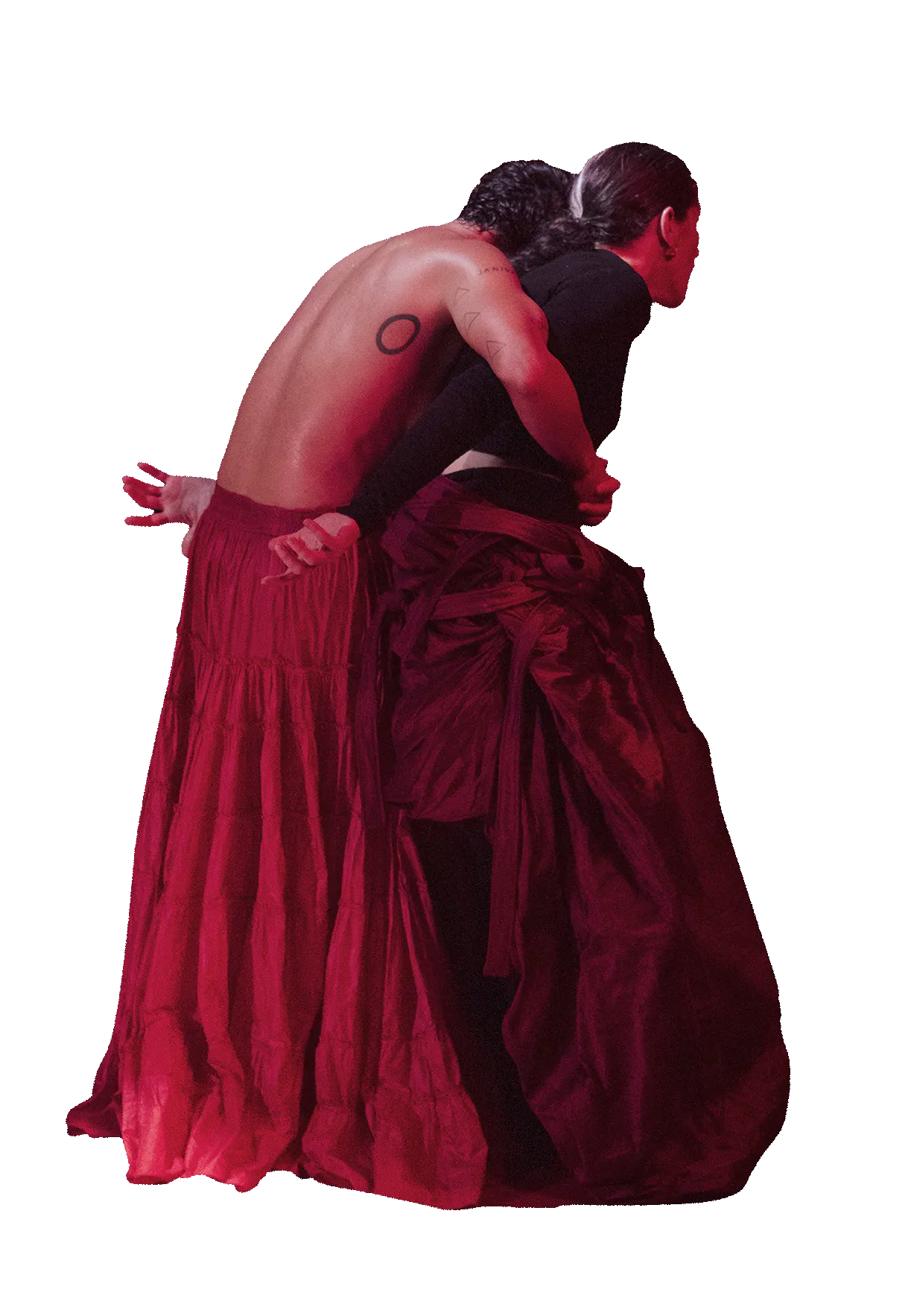
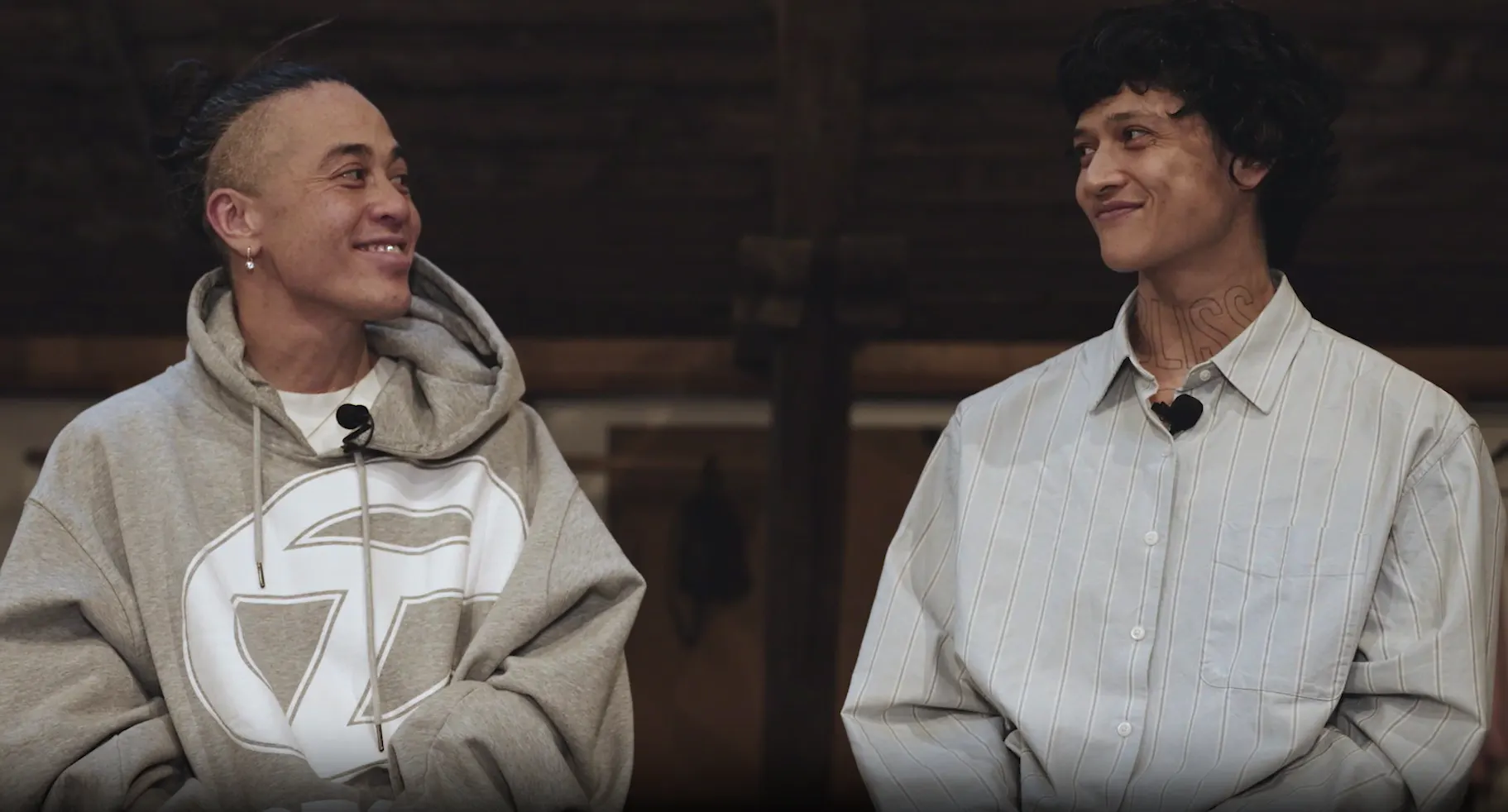
'The creation process has been immensely fun and exciting so far,' says Tsang. 'It is rather rare to have such a richness in the material so soon.' Rare but not surprising in this case. 'This play is the culmination of many years of thinking.'
Wu Tsang and Moved by the Motion have been researching the iconic figure Carmen for years now, leading to a dense web of references, new connections and practices on the way. In early 2024, they premiered their version of the famous opera by George Bizet in which they gave Carmen several new identities, one of which the left-wing rebel dancer La Paloma Roja who fought against Franco's fascist troops during the Spanish Civil War (1936-1939).
The revamped opera two years ago was perhaps the most prestigious of the Carmen-renditions by Moved by the Motion, but only one of many, with an impressive variety in form: film installation, opera, theatre, performance,… only last fall, in the build-up towards strike, on show from 23 April at NTGent, the collective performed a take on Carmen in Tate Modern (London) and during Festival d’Automne (Paris).
The opera Carmen by Bizet premiered in 1875 and tells the story of an independent Roma woman who refuses to succumb to the charms of the army officer Don José, who ends up murdering her - a femicide in a time when violence on woman was portrayed on stage without any criticism. A critic from The New York Times described Carmen in 1878 as a 'wilderness of a woman' who lacked 'the sweet restraint and lovely decency of her sex'. Carmen’s murder was presented in the Bizet-version as a crime of passion.
'Carmen belongs to everybody and nobody,' Tsang has said previously on her fascination for the world-famous character. 'What was a threat to her creators, is now an inspiration to us.'
Captured and killed
For the makers of strike, Carmen is not a wild woman, but becomes an elusive figure: a multifaceted lens through which to view the socio-ecological crises of our time, including the ubiquity of violence against marginalized communities.
'What draws me to Carmen, is her hybridity,' says Tsang. 'She is everything and nothing. She embodies so many qualities that can be reduced to being a femme fatale. But she is multi-faceted and elusive. Carmen is amorphic, ungraspable and mythic.'
'I have always felt a deep interest in the way Carmen has been deified for more than a century now, as an orientalised subject, but at the same times continues to die,' says Basco. 'There is something very prominent around the repetition of her dead. What is it about her that is so valuable that it must be captured and killed? What is it about her that is so captivating to our world, the same world that continues to perpetuate violence toward many kinds of people?'
Every time we share a work with the audience, I carry the same hope: that there is a transmission of caring for each other

Even though retelling – and in doing so expanding the classic story of Carmen - has been a key aspect of the practice of Moved by the Motion, with strike the collective might have reached a tipping point. Starting from a point of exhaustion faced with centuries of fetishizing, moralising, romanticising, and punishing Carmen, the collective will use live improvisation and sonic and cinematic layering to stage less a retelling than an excavation — an attempt to expose the violence embedded in the beauty of the legend and disseminate a message of dissonance.
Representation
While in many renderings, Carmen has been a way to represent groups and identities that commonly lack representation on stage, strike adresses the question of representation on a fundamental level. For Tosh Basco, representation does not suffice. 'There has been a significant increase in visibility for gay, queer, and trans people, for all kinds of people in the very recent past. But it has been shocking to see how quickly that boomeranged back to blatant fascist violence that is committed before our very eyes.'
'Representation can serve access and power, but it scares me sometimes, the amount that people rely on representation to uphold or undo structural systems of power, the consequences of which we are now faced with again.'
I haven’t felt so connected to a subculture as I do to flamenco since being deeply emmeshed nightlife
Tsang spent a lot of time in Seville in recent years, where Bizet set his opera and Carmen lives on as the main tourist attraction. Even though she went of one of the touristic tours and was fascinated by the guide acting as if Carmen had lived in the Spanish city, Tsang's focus has been on getting acquainted with the thriving flamenco subculture there. She is not an expert by far, Tsang stresses, her travels to Seville have been a way to meet people and invite them to collaborate.
'Collaborating allows you to step inside someone else’s knowledge. You can start a conversation, an exploration, a dance. That is how it feels for me with flamenco now: I am learning thanks to our very inspiring partners.'
Stomping
Moved by the Motion calls itself a band of rovers due to its ever-shifting composition and migratory nature yet creating strike feels like a homecoming. Tsang and Basco are joined in the rehearsal room by long-time collaborators Tapiwa Svosve, Josh Johnson and Perle Palombe. The cast is completed by flamenco artists Raúl Cantizano and Sara Jiménez.
'Flamenco is so alive, so energetic and raw,' says Basco. 'I have not felt as connected to a subculture since being deeply emmeshed in nightlife. It must be all the stomping (laughs).'
'Raúl and Sara also bring in a practice of improvisation,' adds Tsang. 'One which we did not encounter when we were researching the more operatic side of Carmen. There is less an impulse to improvise there. It exists but is not nurtured in the same way.'


For Moved by the Motion, strike is a return to familiar ways of working. 'Ways that we’ve been carrying with us for many years but didn’t have the time to focus on recently,' says Tsang, who refers to their collective way of creating, the clashing of genres on stage and composition through iteration.
Working with Moved by the Motion means 'daring to come together in vulnerability,' says Tsang. 'Every time we share a work with the audience, I carry the same hope: that there is a transmission of caring for each other.'
'Over the years, we have amassed connection,' adds Basco. 'It grows in masse, it grows in force, it grows in speed, it’s a really beautiful interweaving between people that feeds me as an artist.'
--- written by Jonas Mayeur and Joshua Wicke