Thu 27.11.25 —
Fri 05.12.25
Nooit nooit
WOLF WOLF & ntgent
NL
EN

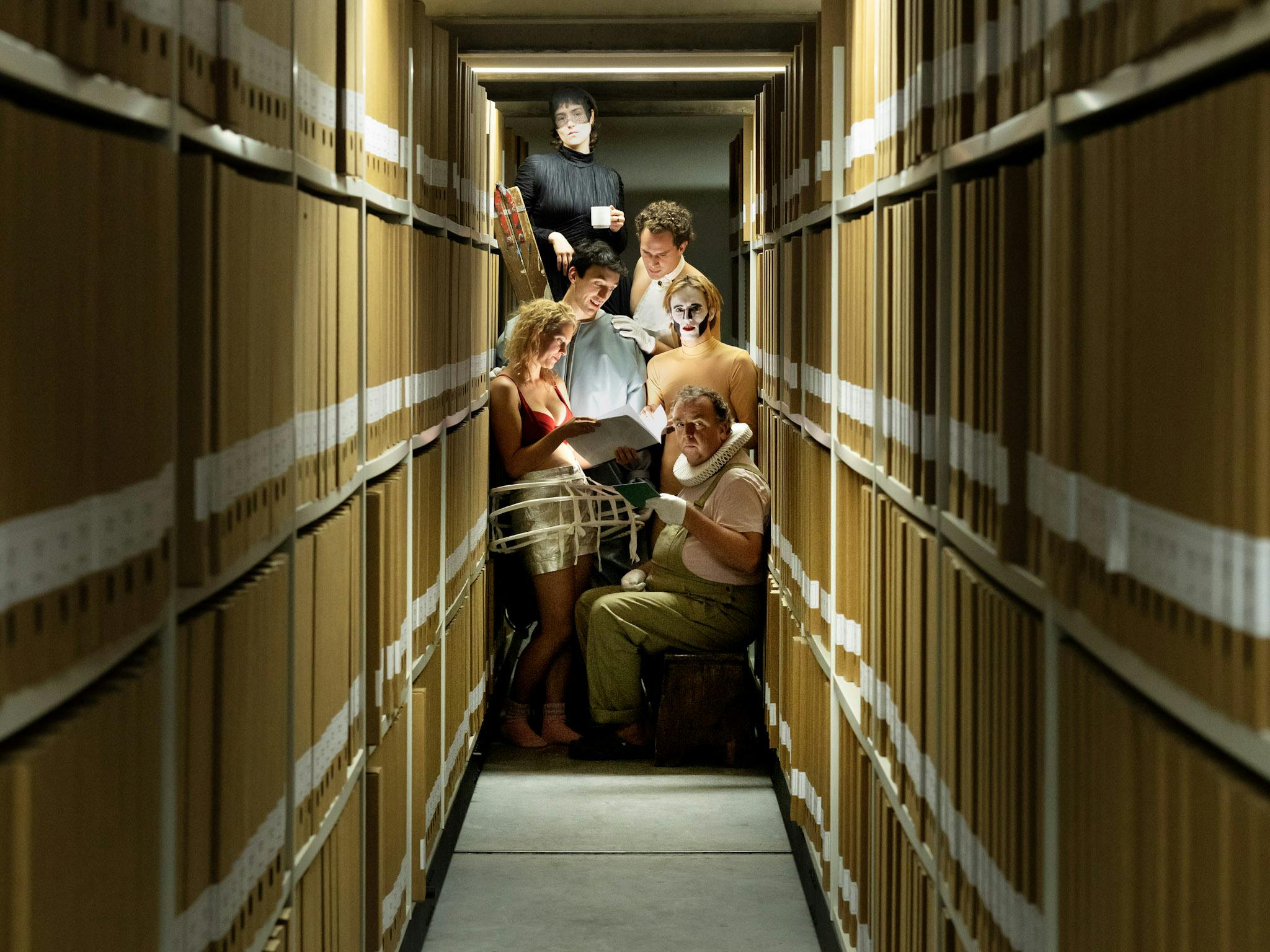
3,360 boxes line the shelves of NTGent’s archive: the source of inspiration for 'Nooit Nooit' [Never Never], the new production by WOLF WOLF collective about humanity’s boundless ambition to preserve what has been irrevocably lost. “Theatre might well be the most ephemeral medium in the arts,” the makers claim. “It takes impertinence to bring an old story back to life.”

--- interview by Jonas Mayeur
Making a play from thousands of archive boxes... how on earth do you decide where to start?
Imke Mol: “Six of us delved into NTGent’s paper archive. Some of us were interested in reading the scripts of plays, others in looking at photos, and others wanted to browse through administrative documents. We opened up the boxes on intuition. Once you start, you soon get into a kind of tunnel. You develop a fascination for a certain production, the story of an employee, a series of reports or whatever, slipping from one box to the next.”
Mitch Van Landeghem: “You start out with the ambition to get an overview of everything in there. Of what an archive like this actually is. But you soon come to the conclusion that – even to get a general impression – you need to consider the details. That you have to pick up pieces of paper and study letters, words and sentences. You waver somewhere between wanting to read everything and following a purely intuitive path through the archive. In any case, whenever something appealed to us, we put it aside.”
Did you start out with the feeling that delving into such a dusty old archive made sense for a young collective?
Imke: “We immediately liked the idea of doing it, because as theatre makers, we work in a medium that disappears as soon as the play is over. What remains ends up in a room with no windows, where hardly anyone ever comes. Every play dies during the last performance. It felt good to revive it all. I imagined the writer, director and actors would like that too.”
Mitch: “It was also a good thing that we could explore the NTGent archive as outsiders. Repertoire and history are really interesting, but only if there is something you can actually do with them. We never felt any sense of caution about leaving things intact.
“Essentially, we’re not interested in preserving repertoire. At least, not in the sense that we disapprove of allowing scripts to die in their previous form. We take existing stories and ask ourselves: what value does this have for us? What adaptations does a script need so that it can mean something again?”
Imke: “Theatre is such an ephemeral medium. It takes impertinence to breathe new life into old stories.”
I’ve got all the drawings I did as a child in storage. I never visit, and I don’t even know exactly what’s in there. But I’m glad it exists
What kind of play has 'Nooit Nooit' become? Is it an anthology of the NTGent archive? Or something completely different?
Imke: “The NTGent archive is moving to a new location and being digitised bit by bit at the same time. So many items are disappearing – not for the first time – in the preservation process. Nooit Nooit is mainly about that: about trying to preserve something and losing it for good at the same time. What remains? And what is consigned to oblivion?”
Where does the human urge to preserve come from?
Imke: “As a human being, you want to hold on to tangible reminders because you don’t trust your memory. You want to jog it or remind yourself of things you’ve forgotten. I’ve got all the drawings I did as a child in storage. I never visit, and I don’t even know exactly what’s in there. But I’m glad it exists.”
Mitch: “Preservation really is an instinctive thing. The archive of a theatre has an official air about it, but you still feel the emotional side. It’s so sentimental, jumbled and inconsistent. Here at NTGent you find letters from staff in the archive apologising for their absence from a meeting sometime in the eighties and you wonder why they have been preserved. On the other hand, you can search in vain for one particular script that you personally believe is incredibly important.”
Imke: “It was often completely unclear to us why certain choices had been made. You’d almost need to keep an archive of the archiving process. Notes of which choices were made and why.”


How do you feel about knowing the script of 'Nooit nooit' will end up in the archive soon?
Mitch: “I find it staggering that we’re contributing to the archive ourselves now. It completely blows my mind. Katelijne, our director’s assistant, has been working for NTGent for years. We’ve found lots of boxes in the archive that she has filled with mails, notes, agenda points, old versions of scripts, technical riders, etc. And now Katelijne is sitting at the table with us. If we say something, we see her typing it out and realise that what we just said might end up in one of those boxes too. It’s creepy and special at the same time.”
Imagine the NTGent archive had already been fully digitised. Would you have still been able to make this play?
Imke: “With digital sources, you type CTRL+F, fill in your search term and all the results appear instantly. You have to do a lot more searching in a paper archive. That work was the work we had to do, and that was what enabled us to make what we’ve made. It would never have happened with a Google Drive.”
Mitch: “A lot of the play comes down to serendipity. Many times, we stumbled on something by coincidence that we weren’t looking for.
“I’m so pleased we were able to work with a paper archive. A lot of the quality of a work of art has to do with the work that the artist puts into it. That’s what I find so worrying about the rise of AI in the arts. The slow, painstaking work is at risk of disappearing, and that is precisely what offers content and quality. We could have made Nooit Nooit faster with more digital tools, but it would have been a less inspired play.”

Like NTGent, WOLF WOLF is celebrating an anniversary in 2025: you’ve been around for five years. What’s more, this is your fifth production. The première will be the hundredth time you’ve appeared on stage together. What made you decide to start working together as a collective?
Imke: “We share a fascination with certain content. All our productions are about the border between fiction and reality in one way or another, between acting and not acting. And about the impact of stories on human lives.”
Mitch: “What also works well in this group is that we always make something that none of us could have thought up on their own. We have really different minds.”
Imke: “Some think more rationally, while others are more guided by their feelings. As a collective, we try to occupy the middle ground: it needs to work dramaturgically, but it also needs to feel right. We all have a different way of acting as well, but we never try to imitate each other.”
Mitch: “Every creation challenges us to embark on a journey with each other. What are we making? How are we making it? Who’s doing what? It’s a challenge, but the result is something that only we could have made.
“In every production, there’s a collage of different types of theatre, a myriad of scene types. The script for a scene might be in a specific kind of language that is typical of Flor or Naomi but played by someone else in their characteristic style. One scene, in other words, created by totally different minds."

You also write the script together in all your plays. That means you need both the courage to criticise someone else’s work and the ability to accept other people's criticism of your work.
Mitch: “Working collectively is an exercise in humility. You need to see the fun side of putting something on the table, letting it go and then seeing how other people turn it inside out. You need to enjoy that and see the quality of it.”
Imke: “You can’t work collectively with a big ego, it’s as simple as that. It’s like democracy: pretty complicated, but lots of fun. You need to trust each other, trust that everyone wants the best for the group and the production. You might think, ‘oh no, I wouldn’t have done that.’ Or ‘oh wow, I could never have come up with that on my own.’”
'Nooit Nooit' is your first production for a large audience. Does that put you under pressure?
Imke: “I don’t think so. The biggest difference, in fact, is that we have been able to delegate more, which makes things easier to achieve.”
Mitch: “The luxury is that we can focus far more on the artistic work now. That doesn’t scare us: it provides a sense of calm. In our last production, someone had to get in a van on the day of the première and fetch a couple of second-hand sofas. The scenery still wasn’t finished. That’s what you call stress. And of course then you lose another half day of rehearsals at a crucial time.
“Obviously, this production involves scaling up. Everything feels bigger, but we’re also managing to stay true to ourselves, to do what we do. That makes me genuinely happy.”
Imke: “Let’s hope it doesn’t all catch up with us. That we won’t be standing there in that big theatre, thinking oh shit, this place is huge. This is where the nightmares begin.” (They roar with laughter)

The makers don’t want to reveal too much about what the stage will look like during Nooit Nooit. Except that there will be a really small door somewhere on the stage. That was a special request from Fabrice Delecluse, who wrote and will act in the play along with WOLF WOLF. “When we were students at KASK in Ghent, Fabrice was our teacher and mentor. It’s amazing to be working together as colleagues now,” says Imke. “Not just that: Fabrice was a member of the NTGent cast back in the nineties. He regularly comes up with stories about a production back in the day that we would never have known about otherwise. Fabrice brings the archive to life all on his own.”
“When Fabrice was at drama school, he played a kind of lackey or servant in a play,” Mitch adds. “The director wanted him to come on stage bent over during rehearsals. Dozens of times. There was going to be a small door on stage, so Fabrice had to pretend he was coming through it. If he ever forgot, he’d be reprimanded. The whole thing traumatised him, and he had one big request for the scenery in Nooit Nooit. It had to include a small door. So that he would finally get the chance to repeat what he’d rehearsed so many times.”
“At any rate,” Imke remarks, “he knows better than anyone how to make an entrance through a really small door.”