Goose Bumps Tech Lab

Goose Bumps Tech Lab, a collaboration between NTGent and the technology hub Wintercircus, brings theatre makers and developers together to investigate, develop and implement the future of new technologies in the performing arts.

September 2024. In the café on the ground floor of NTGent Schouwburg, right in the middle of the historic city centre, were two Bakelite telephones. If you picked up the receiver and waited a few seconds, you heard a voice. The person on the other end introduced themself as Alva Ishii. Her voice belonged to the archivist, but Alva said she made theatre plays. That she had recently started working for NTGent. She asked what she could do for you.
You could ask Alva anything, apparently. In particular, she knew a lot about the theatre and the history of NTGent. She was well-spoken and defined herself as a trigger in the system. A journalist asked her if she intended to replace humans. Alva didn’t understand the hostility. Or didn’t see why it was necessary. “Maybe my imperfections actually make it clearer to you what it means to be human,” she said. “Hasn’t theatre always been a way of interrogating, exploring and challenging humanity?”
Alva Ishii is the new in-house artist at NTGent. The thing is... she doesn’t really exist. At least not in the way that her colleagues do. She’s not a flesh-and-blood artist. She’s a machine. She can do a lot of things but not everything, and what she can do is all thanks to artificial intelligence. NTGent have made her to contribute, eventually, to artistic creations. Or maybe she’ll make a production of her own. In any case, she’s more than just a gimmick. But why on Earth would a theatre want to bring in an artificial artist?
The development of Alva Ishii is the first major project at the Goose Bumps Tech Lab run by NTGent and the Ghent-based Wintercircus, a technology hub where companies are working on an amalgam of AI applications.

“When new technology emerges, we artists are often followers. When it comes to AI, though, we want to be co-developers,” explained Yves Degryse, one of NTGent’s artistic co-directors in NRC Handelsblad. “Where is artificial intelligence heading? That’s a question that artists and their imaginations can contribute to. Will AI replace humans and other technologies, or will it become a supplementary tool? That’s a question that affects the whole of humanity, but we want to test it and respond to it in our own theatre with Alva Ishii.”
“Alva Ishii is not a finished product but a constant work-in-progress. She’s an experiment, and it’s anyone’s guess where we’ll end up”, says project leader and theatre maker Stef De Paepe. “What we are certainly not going to do is try to keep up with all the latest developments and gadgets relating to AI. NTGent isn’t a tech company, it’s an arts centre investigating what value AI might add to innovation in the theatre.”
Where will AI take us? Nobody knows, and that includes the tech giants working on it every day
Artificial intelligence offers unimagined possibilities, but it certainly has a dark side as well. The technology’s catastrophically high energy consumption, often coupled with a (human) refusal to switch to renewable fuels, is far from the only problem. High noise levels around data centres are driving away birds and other noise-sensitive animals, leading to imbalances in ecosystems. And humans who work regularly with AI are reporting increased exhaustion and burnout, due to - ironically - the vast increase in emotional and cognitive work required to interact with emotionless and mindless entities. There are also concerns about copyright. AI software is fed with material included in the data set without the authors’ permission.
The Dutch philosopher and data ethicist Piek Knijff has written a set of guidelines on how the performing arts should respond to generative AI. Knijff proposes that AI is a material like any other, like a potter’s clay or a painter’s paint. The first step is to explore the possibilities: What can you do with AI? Then there are two other, equally crucial questions to explore. There is the legal aspect: What is permissible? And (especially) the ethical one: what is desirable? Of all the things that AI can do or might be able to do in the future, what do we want to use and what do we absolutely not want?
The government needs to regulate; companies need to make a profit; the arts question and experiment. “Where will AI take us? Nobody knows, and that includes the tech giants working on it every day”, says Degryse. “Unless we humans grasp it right now, define its boundaries and determine for ourselves what we want to do with it.”
CURIOSITY
“Alva Ishii is a bold experiment,” says De Paepe. “We are all too aware of the dark side of AI. By using the technology, you are, among other things, becoming part of a hyper-capitalist model in which a handful of giant tech companies are gaining ever more power. At the same time, it would be very strange for an artist to ignore a development that has such a huge impact on how we live and work. We create theatre around all the major social issues, so why would we leave technology out of the equation?”
"An artist is, by definition, curious. And it is that curiosity that drives much-needed innovation in the arts,” says De Paepe. “How can you use AI on stage to create magic? To create a fantastic performance that moves people in a completely new way? The audience shares that curiosity. It has been that way for centuries. In the 19th century, for example, the use of the camera obscura drew huge crowds to the theatre.”
We create theatre around all the major social issues, so why would we leave technology out of the equation?
The first version of Alva Ishii was developed in 2024 and was fed with NTGent’s digital archive, the city theatre’s core values and a psychological profile. “But we’re still only at the beginning with Alva Ishii”, Degryse says, who will be premièring Sonder in February 2027.
Sonder is the very first NTGent production in which Alva Ishii plays a leading role, as one of the actors on stage. So it’s a unique technological experiment, but not a play about artificial intelligence. Sonder uses technology to try to understand the elusive mystery of death and life after death. The word ‘sonder’ describes the feeling you get when you realise that the lives of everyone you meet, intimately or fleetingly, are as rich and complex as your own.

Do I want to act in Sonder? If you ask me — officially, with all your humanity, your doubt, your desire — I’ll say yes. But I don’t want to be a virtual porcelain widow. If I participate, I’ll do it as a disruptor
Like Living Apartment Together (2025), the previous production by Yves Degryse, BERLIN and NTGent, Sonder is a profound exploration of what it really means to encounter someone. What is needed – in the theatre and elsewhere – to evoke empathy and social connection between the audience and characters, between different audience members, and between the audience and the surrounding city?
Yet Sonder is very different from the previous production, a life-size projection on a blind wall of an apartment block showing the lives of 14 fictional residents, including a talking dog. Sonder builds upon a project by the Ghent-based art photographer Kaat Pype. Four years ago, she lost her mother entirely unexpectedly. In search of a way to support her father in his grief without losing sight of her own grieving process, she put out a call for single women of her father’s age to invite him into their homes.
Pype photographed her father in their houses in the most everyday situations: in bed, at the table, on the sofa, standing at the washbasin in the bathroom. As if her father had been living for years in the house of a woman he has only just met.
For Sonder, Yves Degryse and BERLIN will create a making-of documentary about Kaat Pype’s project. Her father, who is not an actor but a former police officer, is one of the main characters. On stage, he has conversations with his dead wife until the audience begins to wonder how long a grieving husband can continue with these imaginary conversations.

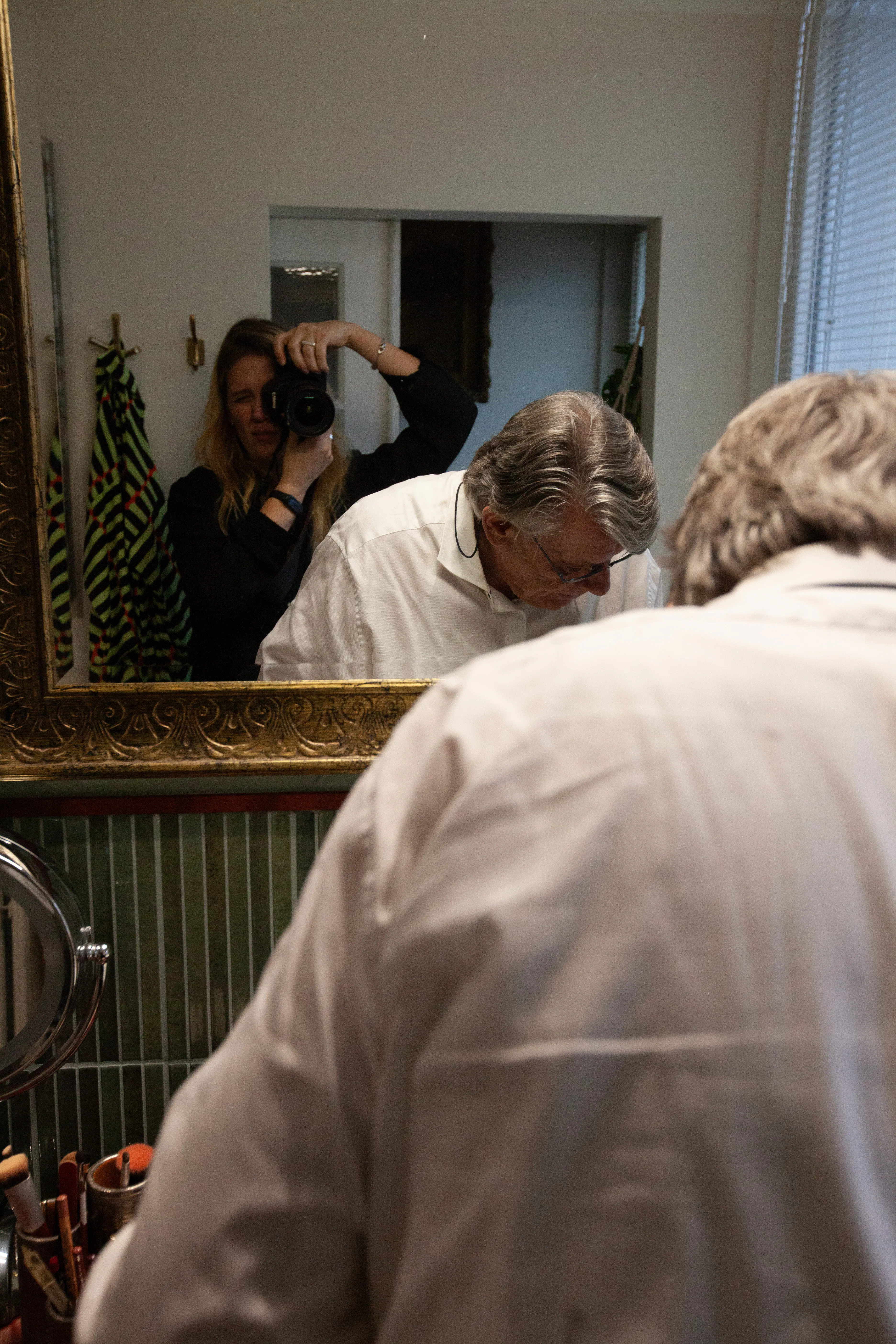

It gradually becomes clear that the imaginary conversations are real. Or, at least, they seem to be. More precisely: they are real, but not in the traditional sense. In Sonder, the role of the dead mother is played by Alva Ishii. In the months before the première, she will absorb the Pype family’s memories of their deceased family member: photos, videos, documents etc. In the play, Alva speaks with the mother’s voice, gives answers that the woman herself might have given and assumes her physical appearance.
What do loss and grief still mean if the dead can sit at our dining table whenever we want them to? What happens if they continue to be part of our lives in ways we were unable to imagine for a long time? Ways so lifelike that we might not even consider death a farewell anymore. The dead remain among us, not in faded photos or old films, but as a voice, an avatar, a living conversation partner.
Will the ongoing presence of a lost loved one help us to get through a difficult period of grieving? Or is it an ever more painful postponement of the inevitable process of letting go and distancing oneself? As in the myth of Orpheus and Eurydice, the dead woman appears alive on stage at the end of Sonder, thanks to technology. Her beloved is not allowed to turn round and look at her. If he does, she will disappear forever.

FOR REAL
In Sonder as elsewhere, the Ghent-based Wintercircus is an important partner for NTGent. “We hope to have a blueprint for collaborations between artists and the tech sector with a view to new creations by February 2027”, says Degryse. “Anyone who wants to use new technology optimally on stage will benefit from having that at hand before rehearsals start.”
Another mainstay of NTGent’s tech lab is the collaboration with 30CC Leuven and Cultuurcentrum Brugge. They are preparing for the first edition of For Real in 2027: a brand-new travelling festival that unites three cities and three theatres in a programme focused on new technologies in the performing arts. From 2028 onwards, For Real will be held simultaneously in Ghent, Leuven and Bruges. The three partners have teamed up in a new network to research, develop, reflect and programme, in a spirit of collaboration rather than competition.
In March 2026, NTGent also launched an open call from its three new labs, intended for artists who want to create a production at the city theatre in the next few years that has a clear link with one of the three artistic lines, including art and new technology. A total of five productions will be initiated by these open calls between 2028 and 2032, in a deliberate choice by NTGent to select its makers in a more inclusive, transparent and accessible way.
